Deep Dive · Oct 13, 2026 · 7 min read
GenAI for Sales: Transcript Pipelines and CRM Integration
How to turn call recordings into structured CRM updates and follow-up drafts, reliably and securely.
 Short version← GenAI for Sales Teams: Faster Follow-Ups and Better Call Prep
The highest-value sales automation is not an email generator. It is a pipeline that captures what happened on a call, structures it, and updates the CRM with the rep's approval.
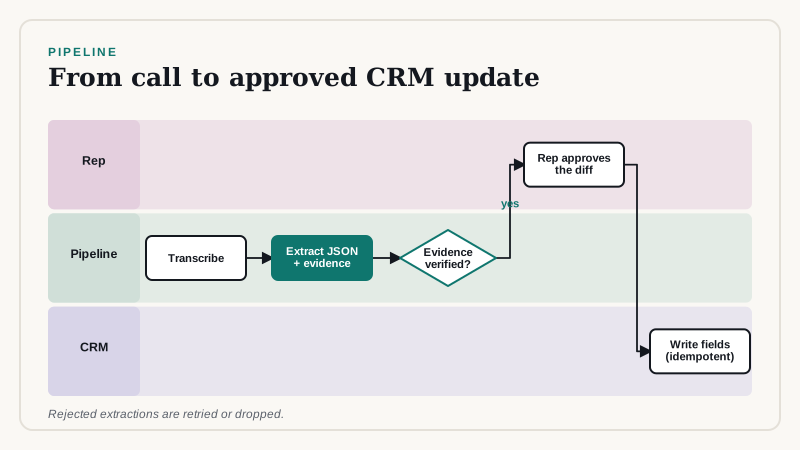
Pipeline
- Capture: recording from the meeting platform, with consent handled.
- Transcribe: speech to text with speaker labels.
- Extract: a structured summary and next steps.
- Draft: a follow-up email from the structured data.
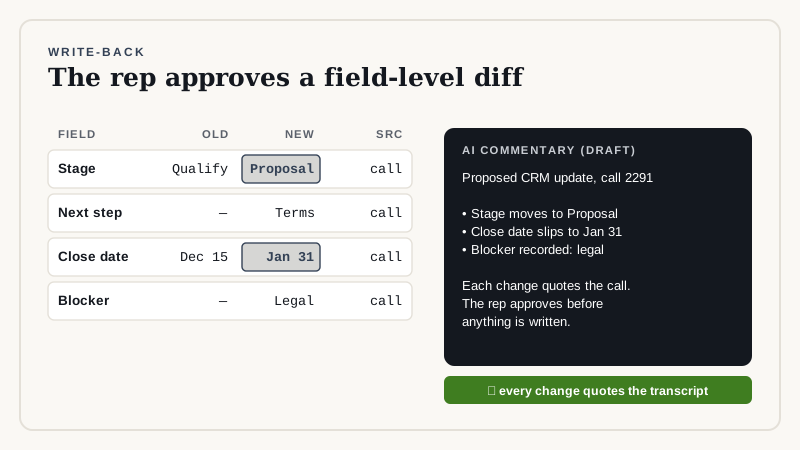
- Write back: update CRM fields after rep approval.
Structured extraction
Ask for JSON with a fixed schema and require quotes from the transcript as evidence. Validate in code, and re-ask on schema errors.
from pydantic import BaseModel, Field
from typing import Optional

class NextStep(BaseModel):
    owner: str
    action: str
    due: Optional[str] = Field(None, pattern=r"^\d{4}-\d{2}-\d{2}$")

class CallSummary(BaseModel):
    summary: str = Field(max_length=600)
    pain_points: list[str]
    next_steps: list[NextStep]
    evidence: list[str]            # verbatim quotes supporting the above

def extract(gateway, transcript) -> CallSummary:
    raw = gateway.complete("sales_extract", "large", build_messages(transcript), temperature=0).text
    return CallSummary.model_validate_json(raw)
Checking evidence
Verify that each evidence quote appears in the transcript. Quotes that do not are a strong sign of invented content, and the whole extraction should be rejected.
def evidence_ok(summary: CallSummary, transcript: str) -> bool:
    t = " ".join(transcript.split()).lower()
    return all(" ".join(q.split()).lower() in t for q in summary.evidence)
CRM write-back
- Write only to fields the rep has approved, and show the diff.
- Use the CRM's official API, with a service account and least privilege.
- Make updates idempotent using the call id.
- Log every change for audit.
Privacy and consent
Recording laws and company policies vary. Announce recording, store transcripts securely, apply retention limits, and avoid sending sensitive personal data to external models unless contracts allow it.
Matching people and accounts
A summary is only useful if it lands on the right record. Match the call to a CRM contact by meeting attendees' emails first, then by calendar event, and ask the rep to confirm when the match is ambiguous. Never write to a record on a fuzzy match without confirmation.
def match_account(attendee_emails, crm):
    for email in attendee_emails:
        contact = crm.find_contact(email=email)
        if contact:
            return contact.account_id, "exact_email"
    domains = {e.split("@")[1] for e in attendee_emails}
    candidates = [a for d in domains for a in crm.find_accounts(domain=d)]
    if len(candidates) == 1:
        return candidates[0].id, "domain_unique"
    return None, "needs_rep_confirmation"
Qualification frameworks
If your team uses a framework for qualifying deals, encode its fields in the extraction schema and let the model fill them only when the transcript supports them. Return null for missing fields instead of guessing. Reps trust a tool that admits gaps.
Drafting emails safely
- Generate from the structured summary, not the raw transcript, so the draft contains only extracted facts.
- Keep a list of claims the rep should not make, such as pricing and legal terms, and block them.
- Show the rep the evidence quotes next to the draft.
- Add the rep's own style from past emails as examples.
Measuring the impact
Track time spent on admin per call, CRM field completeness, follow-up speed, and rep adoption. Where possible, compare reps using the tool with a similar group not yet using it. Leading indicators such as follow-up speed move first; revenue effects take longer and need care before attributing.
Privacy and compliance notes
- Confirm recording consent in every jurisdiction where you operate.
- Limit who can read transcripts, and set a retention period.
- Check provider terms before sending call content to external models.
- Offer reps a way to exclude sensitive calls.
Rollout approach
Start with five reps who want the tool. Collect their edits to summaries and drafts, fix the schema and prompts, then widen. Publish a short guide with examples, and hold a monthly review of accuracy using a sample of calls checked by a manager.
How we can help
We integrate call capture, extraction, and CRM write-back with your existing stack and run an accuracy evaluation on your real calls. Contact us to scope a pilot.
Related reading
Need help implementing this?
Our consultants run architecture reviews and build production pilots. Book a free scoping call to talk through your design.
Book a Free Scoping Callor email us at hello@deepvero.com